
International Business and Business Model Innovation
The sea has such extraordinary moods that sometimes you feel this is the only sort of life—and ten minutes later you’re praying for death (Prince Philip)
An excerpt from the forward by Mark Casson, Professor, Department of Economics, University of Reading, and Henley Business School, to the "De-internationalization and Re-internationalization of the Firm: Business Model Innovation for Growth and Survival" book by Sort, Taran, Turcan (2025):
“This is a very interesting and thought-provoking book. The authors highlight the continuing process of adjustment and re-adjustment of business structure and business strategy that is necessary for firms to survive and grow in a volatile and competitive global economy. The authors point out that firms must be prepared to internationalize, de-internationalize, and re-internationalize as circumstances dictate and recommend that business leaders adopt a business model innovation approach, which they discuss in an informative and accessible way. This is good news for the international business profession, and for business executives too, as it means that abstract theories and practitioner-oriented theories are converging on a common approach to contemporary issues in global business. This book is therefore to be welcomed, not only for its practical wisdom but also for its contribution to an evolving theoretical approach which can shed new light on the international busi-ness system as a whole.”
Research programmes are essential for generating and advancing new, interdisciplinary knowledge and research fields. Drawing on TBRP research programmes, the International Business - Business Model Innovation (IB-BMI) research programme is founded on the following key elements or sets of (1) theory building and methodological strategies, (2) interrelated theories, and (3) phenomenal, theoretical and empirical models.
The IB-BMI research programme offers numerous opportunities for research, teaching and learning, doctoral training and knowledge transfer collaboration internationally to advance beyond the-state-of-the-art knowledge not only at the intersection of International Business and Business Model Innovation, but also at each of these two disciplines.
The IB-BMI research programme offers a 5ECTS, inter-disciplinary, inter-technology PhD course in 'International Business - Business Model Innovation' aimed to aquatint Doctoral Candidates, across various disciplines, departments and faculties, with opportunities and challenges firms – small or large, new or established, low- or high-tech – may encounter while innovating their internationalization, de-internationalization, and re-internationalization business models and strategies.
The IB-BMI research programme is co-coordinated by Jesper Sort and Jonas Eduardsen of Aalborg University Business School. Please contact Jesper or Jonas to inquire into any matters regarding the IB-BMI research programme, including partnering with us to push the boundaries of the state-of-the-art and training Doctoral Candidates.
The framework of the IB-BMI research programme is founded on the promising potential of the symbiosis between these two research streams, International Business and Business Model Innovation.
Specifically, a symbiosis between pattern, capacity and (dominant) logic of the three types of International Business, internationalization, de-internationalization, and re-internationalization and the five value drivers of business model innovation: value proposition, value segment, value configuration, value network, and value capture. The IB-BMI research programme framework is presented in Figure below (Sort, Taran, Turcan 2025, p. 120).
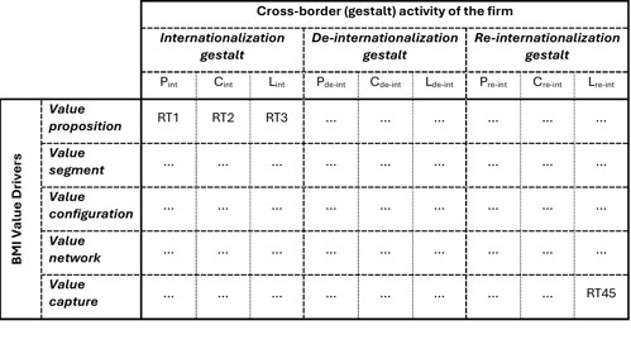
An intersection between an IB element and a BMI value driver defines a potential research theme (RT) that can be problematized, conceptualized, and studied. At least 45 potential research themes can be pursued independently within the IB-BMI research programme from phenomenal, theoretical, methodological and empirical perspectives. The IB-BMI research programme, its potential sub-programmes and research themes are international, interdisciplinary, inter-technological and inter-sectoral.
Future research at the intersection of these two research streams and cultures will contribute to a better understanding of firms’ currently under-researched, nonlinear cross-border activities. It will have an impact on practice by leading to a better understanding of how firms can reconfigure or reinvent their business models during failure, growth, decline, or (strategic) departure from what is normal or expected. It will undoubtedly create more questions than answers, making it an exciting, thought-provoking avenue for future research and practice pondering in a VUCAD world.
 |
Petri Ahokangas is a Professor at the Martti Ahtisaari Institute (University of Oulu) which he leads. His research focuses on how innovation and technological change affect international business creation, transformation, strategies in high-tech, software-intensive firms. With over 170 publications, he is active in national and international research projects. |
 |
Ceara Crawford is a CEO of Yukon Venture Angels. She is advocating for Yukon to be a sandbox for innovative business models, emphasizng the intersection of international business, innovation, and social impact, showing how reimagining investment mechanisms can foster economic sovereignty, expand participation, and transform local and global markets. |
 |
Nikolai Kazantsev is a Research Associate at the Institute for Manufacturing and Research Fellow at Clare Hall, both at the University of Cambridge. Nikolai’s interdisciplinary research interests focus on system-level methodologies to develop, reconfigure, and deploy manufacturing and service capacities across supply chains. |
 |
Lorenzo Massa is a Professor at the Aalborg University Business School, a director with Change Logic LLC and member of the World Economic Forum’s expert network for Innovation. Passionate about commercialization of scientific discoveries and emerging technologies, his research is at the intersection of strategy, innovation, and sustainability. |
 |
Lucia Mortensen is the Head of Research and Education at GreenLab. She advocates for attracting more international research projects and positioning GreenLab as a global role model for sustainable industrial clusters. Lucia is a co-founder of the Danish Symbiosis Network alongside organizations such as Kalundborg Symbiosis. |
 |
Matthias Zach is a Startup Innovation Lead, Digital Health Innovation, at Roche Diagnostics. He has rich experience in working in the medical device industry, with various positions held in the pharmaceutical and life sciences industries. Matthias leads a team that coaches startups in various programs and regional/local innovation hubs. |